Pillar guide · Engagement rings
The Engagement Ring Buying Guide — Everything You Actually Need to Know
~18 min read

Buying an engagement ring is one-time, high-anxiety, and genuinely expensive. Most guides you'll find online are published by retailers trying to sell you a ring: useful for basic terminology, suspect anywhere it affects what you spend. The Knot, Brilliant Earth, and Blue Nile all publish guides that recommend going heavier on carat and higher on color than almost anyone needs.
This is the path we'd walk a friend through. Ten steps, each with a deep-dive link if you want more. The short version: pick a budget, protect the cut, trade color and clarity down to hit your carat target, get the certificate from GIA or IGI, and compare the exact same spec across at least three stores before you buy. Do those five things and you'll pay roughly 20–30% less than the person who walked into a mall jeweler and said yes to the first setting they liked.
Step 1
Set a budget
Forget rules. The "two months salary" line came from a De Beers ad campaign in the 1930s, not a financial planner. Three months was added later by the same agency. Neither is a useful benchmark for what a ring should cost; both are marketing artifacts.
The current median US spend is around $5,500 and has been trending down for a decade, mostly because lab-grown diamonds let buyers get a bigger stone for less money. The right budget is the largest number you can spend without going into debt or pulling from savings you actually need. If you're buying lab-grown, that number gets you substantially more ring than it used to.
For the full breakdown by income, location, and retailer type, see our guide on how much an engagement ring should cost.
Step 2
Understand the 4Cs
Every diamond is graded on four axes: cut (how well the stone is faceted), color (how colorless it is, D to Z), clarity (how few inclusions it has, FL to I3), and carat (weight, not size). The GIA developed this system in the 1940s and it's still the only objective way to compare two diamonds sitting in different stores.
Our strong opinion: for beauty per dollar, the ranking is Cut > Color > Clarity > Carat. Cut controls brilliance, so a poorly cut diamond looks dim at any color or clarity. Color matters less than most buyers think. H is the sweet spot for white gold, J is fine in yellow gold. Clarity only matters up to "eye-clean," which is usually VS2. Carat is the biggest price driver but the smallest beauty driver.
The practical takeaway: pay for cut, trade color down to G or H, land on VS2 for clarity, then buy as much carat as the budget allows. For the full mechanics (plus how "magic size" pricing works), read our diamond 4Cs guide.
Step 3
Pick a shape

Shape is the first thing anyone notices. Round brilliants are around 60% of the engagement ring market, oval is the fastest-growing shape at roughly 15–20% and climbing, and cushion, princess, emerald, pear, and the rest split the remainder.
Shape has a real dollar impact. Round brilliants command a 30–40% premium over fancy shapes with the same carat, color, and clarity. Two reasons: round requires the most rough diamond to produce (roughly 60% of the rough is wasted), and demand is highest. If the wearer is open to it, ovals, cushions, and pears give you a meaningfully bigger stone for the same budget.
What we'd tell a friend: shape is more about their taste than anything else. Don't try to talk someone into a shape they don't want because it's cheaper. But if they're undecided between two shapes (which happens often with round vs oval), the cheaper of the two is genuinely a good answer.
For shape-by-shape tradeoffs (which shapes hide inclusions, which show color more, which face up biggest), see our engagement ring shapes guide. To shop by shape now, try round engagement rings or oval engagement rings.
Step 4
Pick a setting style

The setting is the metal scaffolding that holds the stone. The classic options:
- Solitaire: one stone on a plain band. The most common choice, and the one that shows the center stone most honestly. Four- or six-prong.
- Halo: a ring of small diamonds circling the center stone. Makes the center look about 20% bigger, adds sparkle, and lets you go smaller on the center stone without it looking small.
- Three-stone: center stone flanked by two smaller side stones ("past, present, future"). Adds width on the finger and can look a full half-carat larger than its center stone suggests.
- Pavé: tiny diamonds set along the band itself. Most popular modern variation. Adds sparkle everywhere; can't easily be resized.
- Vintage: filigree, milgrain, and hand-engraved details. Lovely on the right hand, fussy on the wrong one. Usually harder to resize and repair.
- Bezel: metal wraps fully around the stone. Lowest-profile, most durable, most protective. Great for active hands; hides some of the stone's light return.
Our default recommendation when the wearer is undecided: solitaire or halo. Both are safe, both age well, and both can be upgraded later. For a deeper tour with live examples at each price point, see our engagement ring styles guide.
Step 5
Pick a metal
Four options cover almost every engagement ring sold in the US: platinum, 18k gold (white, yellow, or rose), 14k gold (same colors), and occasionally palladium. The short version of what differs:
- Platinum is the most durable and the densest, roughly 60% heavier than 18k gold at the same volume, which is part of why it costs more. Naturally white, doesn't need replating. Prices about 30% above 18k white gold for an equivalent setting.
- 18k white gold looks identical to platinum at purchase, but the white color comes from a rhodium plating that wears off every one to three years. Replating runs about $50–$100 each time.
- 14k white gold is the most common choice in the US. Slightly harder than 18k (more alloy, less pure gold), replates the same way. Prices roughly 15% below 18k.
- Yellow and rose gold (14k or 18k) don't need replating. The color is the alloy, not a coating. Rose gold is a style choice, not a durability one; it doesn't hold up better or worse than yellow.
Practical default: 14k white gold if budget matters, platinum if it doesn't. Yellow or rose gold if that's what the wearer already owns and leans toward.
Step 6
Lab-grown or natural?

This is the biggest decision you'll make. Lab-grown diamonds are chemically identical to natural diamonds. Same element (carbon), same crystal structure, same hardness, same light behavior. A lab-grown diamond is not a simulant like cubic zirconia or moissanite; it is a real diamond grown in a lab instead of pulled out of the ground.
The price difference is enormous and widening. At wholesale, lab-grown runs 70–85% cheaper than natural at equivalent specs, and retail prices reflect roughly the same ratio. A 2-carat lab-grown H VS2 might cost what a 1-carat natural H VS2 costs. Nobody looking at the ring can tell them apart; most jewelers can't without a machine.
The catch is resale. Natural diamonds historically recover 30–50% of purchase price on resale. Lab-grown recover 10–20%, and that number is falling as production ramps up. If you ever plan to sell or trade in, natural holds its floor better. That said, few people actually resell engagement rings, so in practice this matters less than it sounds.
Our take, assuming size matters at all: if you'd otherwise buy a 1-carat natural, buy a 2-carat lab-grown for the same money. If size doesn't matter, buy a 1-carat lab-grown and spend the savings on a better cut grade, a nicer setting, a honeymoon, or literally anything else. The only reason to buy natural is if the wearer has a strong preference for it, and some do. Ask.
For the full numbers, the sustainability argument (not as clean as the lab-grown marketing suggests), and how each is certified, read our lab-grown vs natural diamond comparison.
Step 7
Get the ring size right
US ring sizes run roughly 3 to 13 in half-size increments. The average US women's size is 6–6.5; average men's is 10. If you genuinely have no clue, start there and plan to resize. Better: borrow a ring they already wear on the correct finger, trace it on paper, and bring the tracing. Best: order a cheap plastic sizer off the internet and test it on a ring they leave at home overnight.
Resizing tradeoffs matter at purchase time. Solitaires resize up or down two sizes with no drama. Full pavé bands resize one size with refitting. Eternity bands, with stones all the way around, cannot be resized; you'd have to remake the ring. If you're unsure on size and considering eternity, propose with a simple solitaire and let them pick the eternity band together. Our ring size chart has the full mm-to-size table and three different ways to measure without asking.
Step 8
Check the certificate
A grading report from an independent lab is the single document that makes a diamond comparable across stores. Without it, you're buying the retailer's word. Three labs worth knowing:
- GIA: the Gemological Institute of America. The strictest and most trusted for natural diamonds. A GIA-certified stone carries a roughly 5–10% premium over the same stone with no report, and the premium is worth paying.
- IGI: the International Gemological Institute. Widely used for lab-grown diamonds; most online retailers like James Allen and Blue Nile use IGI for their lab-grown inventory. Slightly looser than GIA historically, but for lab-grown specifically the two labs are roughly aligned.
- AGS: was the most rigorous cut-grading lab in North America. Acquired by GIA in 2022, so new AGS reports are rare; older AGS-graded stones still trade and are perfectly trustworthy.
Anything above $1,000 should have a report from GIA or IGI. Avoid EGL (consistently grades 1–2 grades looser than GIA) and in-house "store appraisals," which aren't independent. For the deeper mechanics, see our diamond certification guide and the GIA vs IGI comparison.
Step 9
Compare prices across stores
This is the step most other guides gloss over, and the one that saves you the most money. The same spec engagement ring (same shape, same carat, same color, same clarity, same cut, same metal) varies 15–40% in price between retailers. We see it every day in our own price data.
The broad pattern: online-native retailers beat physical chains decisively. Blue Nile, James Allen, and Brilliant Earth typically price 30–50% below Kay, Zales, and Jared for equivalent quality, partly because online retailers don't carry mall rent and partly because they don't mark up for in-person sales commission. Within the online group, differences run 10–20%; within the chain group, less.
The practical workflow: decide on spec (shape, carat, color, clarity, cut), then search that exact spec at three retailers before buying. If you're on DiamondCodes, our engagement rings page shows live prices across every retailer we track, sorted by price. For the store-by-store roster, see our store directory.
One more thing: stack a coupon where possible. Many online retailers run 10–20% promos on settings throughout the year. Our coupon page tracks the live ones.
Step 10
Buy, insure, and enjoy
Buy direct from the retailer. Every link on DiamondCodes goes to the retailer's own site; we're affiliate-disclosed, the price is the same whether you click from us or type the URL, and clicking through us supports the site. Use a credit card for the purchase protection, not a debit card or bank transfer.
Before the ring leaves the retailer, get an appraisal. They'll include one, or it costs $50–$100 to get independently. You need it for insurance. Home insurance riders from major carriers (State Farm, Allstate, USAA) typically cost 1–2% of the ring's value annually. Dedicated jewelry insurers like Jewelers Mutual price similarly and cover more cases (loss anywhere in the world, not just theft at home).
Full details (what a rider actually covers, how the claim process works, and why you should insure the day the ring arrives, not the day after the proposal) are in our engagement ring insurance guide.
Common mistakes to avoid
- Overspending on clarity. VS2 and VVS1 look identical to the eye. Paying for FL or IF adds 30–50% to the stone price for zero visible difference. VS2 is almost always the right answer.
- Paying mall-chain markup. Kay, Zales, and Jared are the default because they're in every mall. That's also why they're 30–50% more expensive than online equivalents. If you're deliberately paying for the in-person experience, fine. But know the premium.
- Skipping the certificate to save $200. A non-certified diamond is worth whatever the next buyer says it's worth, which is usually a lot less than what you paid. The report premium pays for itself on resale and on trade-in.
- Ignoring the cut grade. Cut is the biggest driver of whether a diamond looks beautiful. A 1.30ct stone with a Good cut looks smaller and duller than a 1.00ct stone with an Excellent cut. Never buy below Very Good on rounds; target Excellent.
- Forgetting about sizing until the ring arrives. A ring that's a full size too big will spin on the finger; too small and it won't go on. Measure twice, resize once.
- Buying blind, not comparing across stores. The biggest money leak in engagement ring buying. Same spec, different retailer, easily 15–40% price gap. At least three stores, every time.
Timeline: how early to start
For a stock ring from an online retailer, start shopping two to three months before you plan to propose. Two weeks for picking the ring, two weeks for delivery and sizing, two weeks of slack for anything that goes wrong (wrong size, insurance setup, an inclusion you spot in person that you missed online).
For a custom or bespoke ring, double it: four to six months. Custom settings take four to eight weeks to fabricate on top of sourcing the stone, and the back-and-forth on CAD renders adds another two weeks if you're being picky. If you're traveling to propose, add another week for shipping. Start earlier than you think you need to; you can always sit on a finished ring, but you can't rush a jeweler.
Live examples at three budgets
Rather than quote numbers that'll be wrong by next week, here are three live engagement rings from our comparison feed at different price points, pulled at build time from retailers we track.
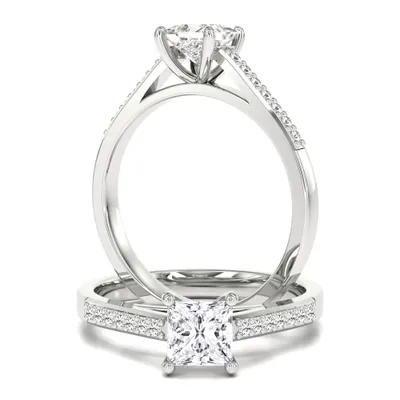
Purely Diamonds
An elegant lab grown princess cut diamond ring with shoulder stones in 18ct white gold
$1,610
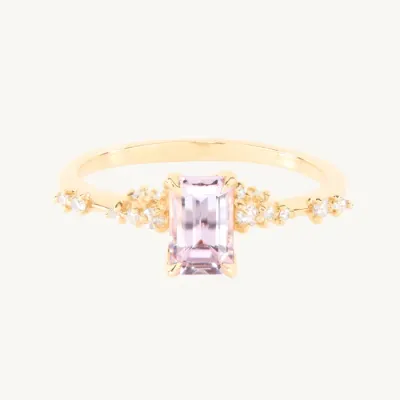
Catbird
Daphne Pink Sapphire Solitaire Ring
$4,198
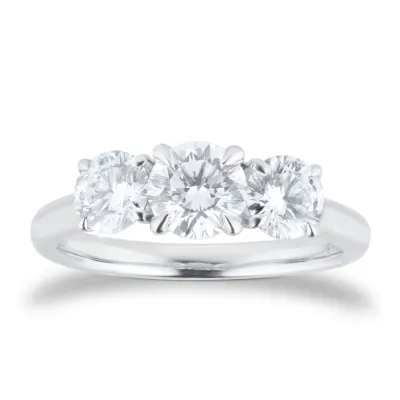
Goldsmiths
Exclusive Platinum 1.50cttw Brilliant Cut 3 Stone Goldsmiths Signature Diamond Engagement Ring
$8,500
For the always-current list at every budget, start on the engagement rings page and filter by price, carat, or shape.
FAQ
Where's the best place to buy an engagement ring?
For most buyers, the best value is online-native retailers like Blue Nile, James Allen, and Brilliant Earth, which typically price 30–50% below mall chains for equivalent quality. The "best" store depends on what you're buying, though. Our store directory lets you compare live prices for the same spec across every retailer we track.
Is it safe to buy an engagement ring online?
Yes. Every major online retailer offers 30–60 day return windows, free insured shipping, and certified grading reports. You'll see far more detail online (360° videos, high-res macro images, ASET images) than you will in any physical store. The main risk is sizing, and that's easily fixed.
Lab-grown or natural?
If size matters to the wearer, buy lab-grown. You'll get roughly twice the carat weight for the same money at equivalent quality. If long-term resale or tradition matters more, natural holds value better. Most buyers we talk to regret going smaller on natural more than they regret going lab-grown. See our full comparison.
Do I need an appraisal?
Yes, for insurance. Every major retailer includes one with the ring or can provide one. Don't confuse an appraisal with a grading report: the report is the objective grade, the appraisal is a retail replacement value (which is usually inflated 20–40% above what you actually paid).
What about resizing?
Most solitaires resize cleanly up or down two sizes. Eternity bands with stones all the way around can't be resized; you'd have to remake the ring. Full pavé bands can usually be resized one size with some refitting. If you're guessing, size up and resize down; ring fingers swell and shrink by up to a half size in a day.
How do I keep it a secret while shopping?
Use incognito mode and a personal email. Clear your browsing history if you share a computer. Borrow one of their existing rings to trace or measure instead of asking. When a retailer ships, have it sent to your office or a friend's house rather than your shared address.
What if I pick the wrong ring?
This is why we tell everyone to propose with something simple (often a plain solitaire) and let them pick the setting together afterwards. Most online retailers also allow a setting swap within the return window, and some (Brilliant Earth, Blue Nile) offer free upgrades within the first year.
Can I return an engagement ring?
Yes, almost always. The major online retailers offer 30 to 60 day no-questions returns, and most physical chains offer at least a 30-day window. Custom engraving and custom settings are often final sale, so hold off on those until after the proposal.
Next steps
Deep dive
The Diamond 4Cs
Cut, color, clarity, carat: what actually matters and where to save.
Deep dive
How much should an engagement ring cost?
The real median, not the "three months salary" myth.
Deep dive
Engagement ring shapes
Round, oval, cushion, princess, and the rest, priced and compared.
Compare
Lab-grown vs natural diamond
The biggest decision in engagement ring buying, with real numbers.
Shop
Engagement rings
Live prices compared across many online jewelers — filter by shape and price.
Browse
Store directory
Every retailer we track, with live pricing and coupon coverage.
Sources
- GIA — The 4Cs of Diamond Quality (canonical definitions for cut, color, clarity, carat).
- GIA — GIA-AGSL acquisition (2022) (end of independent AGS grading).
- The Knot — Engagement Ring Buying Guide (industry reference and source for average-spend data).
- Rare Carat — Diamond education hub (independent buyer's-guide reference).
- De Beers — Diamond Insight Reports (market context on shape distribution and category growth).