Diamond type · Comparison
Lab-Grown vs Natural Diamond — The Honest 2026 Comparison
~14 min read

Lab-grown and natural diamonds are chemically, physically, and optically identical. Same carbon lattice, same refractive index, same 10 Mohs hardness. The differences are all outside the stone: origin, price, resale value, scarcity narrative, and the story the wearer wants it to carry.
That matters because lab-grown volume has now caught up with natural in engagement ring units, even though it's still well behind in revenue. Wholesale prices for lab-grown have collapsed: down roughly 80% since 2018, and another 26% in 2025 alone (Edahn Golan Diamond Research). Most of the guides online were written before that price crash, and most retailer pages are written to sell you a specific thing. This page is not that. Below is our straight-talk read on where lab-grown wins, where natural wins, and where the sales copy on both sides is thin.
If you only read one thing…
- Same material. A lab-grown diamond is a real diamond, not a simulant. GIA and IGI grade both on the same cut, color, clarity, carat scale.
- Lab-grown is 70–85% cheaper wholesale and 60–80% cheaper at retail for equivalent specs. At the same budget, lab-grown gets you a stone roughly 2–3x larger.
- Lab-grown resale is poor. Expect 10–20% of your purchase price back versus 30–50% for natural. If resale or heirloom value matters, lab-grown is a bad fit.
- Pick based on what you're optimizing for. Biggest visible stone for the money → lab-grown. Billion-year-old story, resale, heirloom → natural.
Shop both sides with live prices: lab-grown engagement rings or the full engagement ring catalog.
Side-by-side spec comparison
The top three rows of this table are the part retailers sometimes glide past: a lab-grown diamond and a natural diamond of the same carat, color, clarity, and cut are physically indistinguishable. A gemologist with a loupe can't tell you which is which. Only a grading lab, with equipment that reads trace nitrogen and phosphorescence patterns, can separate them. Everything that actually differs between the two sits below the identical-material rows: origin, price, resale, supply dynamics, and the sentimental frame.
Below, same-spec stones across the full picture.
| Spec | Lab-Grown | Natural |
|---|---|---|
| Chemical composition | Pure carbon (C) | Pure carbon (C) |
| Optical properties | RI 2.42, dispersion 0.044 | RI 2.42, dispersion 0.044 |
| Hardness (Mohs) | 10 | 10 |
| Origin | Grown in a lab (HPHT or CVD) over 2–4 weeks | Formed 1–3 billion years ago under the earth |
| Typical wholesale price, 1ct round | ~$200–400 | ~$4,000–8,000 |
| Retail discount vs equivalent natural | 60–80% cheaper | Full market price |
| Typical resale recovery | 10–20% of purchase | 30–50% of purchase |
| Supply | Made to order; effectively unlimited | Mined; finite and shrinking |
| Environmental impact | Low land/water use; energy-intensive (mix varies) | Significant mining footprint; heavily regulated at major modern mines |
| Story the stone carries | New technology; chosen for value or ethics | Billion-year-old stone; scarcity and heirloom narrative |
Highlighted rows: physically identical properties. Every other row is where the real decision sits.
How lab-grown diamonds are made
Two production methods dominate today: HPHT (High Pressure High Temperature) and CVD (Chemical Vapor Deposition). GE first synthesized gem-quality diamond in 1954 under Project Superpressure, using an HPHT press. CVD came later, starting in the 1980s, and is now the more common process for large and high-clarity stones.
HPHT
HPHT recreates the conditions deep in the earth's mantle: roughly 5 GPa of pressure and temperatures above 1,300°C. A tiny diamond seed sits in a press with a carbon source (usually graphite) and a metal solvent-catalyst (iron, nickel, cobalt). Under that pressure and heat, carbon atoms dissolve into the metal, migrate toward the cooler seed, and crystallize on it as new diamond. The whole growth cycle runs days to a few weeks, depending on target size.
CVD
CVD works at the opposite end: low pressure, moderate temperature, and a plasma of carbon-rich gas (usually methane plus hydrogen) inside a sealed chamber. Microwaves ionize the gas; carbon atoms separate from the plasma and deposit, layer by layer, onto a thin diamond seed plate. The grown crystal is a tabular slab that's later sawn and cut into round brilliants, ovals, and so on.
CVD is cleaner to run at scale, uses less exotic equipment, and has, critically, surpassed HPHT for producing very clean, very colorless, very large stones. Most of the price collapse in 2023–2025 came from Indian CVD producers adding reactor capacity fast enough to tip the market into oversupply.
Both methods produce gem-quality diamond. A well-graded HPHT stone and a well-graded CVD stone are indistinguishable face-up; the differences sit in grading-lab-only traces (nitrogen patterns for HPHT, silicon impurities for CVD, faint strain patterns under cross-polarized light for both). Neither method is "better" at the retail level. Pick on cut grade, clarity, and price, not on growth process.
Price: the single biggest difference
This is the section most guides soften. We won't.
Lab-grown wholesale prices have collapsed roughly 80% since 2018, with a further 26% decline in 2025 alone (Edahn Golan). A 1-carat round lab-grown wholesales in the $200–400 range as of early 2026; a 1-carat round natural of comparable color and clarity wholesales in the $4,000–8,000 range. Retail margins compress that gap, but not by enough to close it: at retail, lab-grown typically runs 60–80% below the natural equivalent.
The practical effect is simple. At a fixed budget, lab-grown buys a visibly larger stone. $3,500 gets you roughly a 1.0ct ideal-cut natural or a 2.5–3.0ct ideal-cut lab-grown of similar color and clarity. If the person wearing it cares about face-up size more than origin, that's a real advantage and hard to argue around.
Where is the market going? Lab-grown prices are still falling, but the pace is slowing. Reactor capacity is becoming a commodity; input costs (electricity, labor, seed crystals) now set the floor. Natural pricing, meanwhile, is holding. There's been slight compression in mid-market 0.5–1.0ct goods, but the top end (3ct+, D–F, IF–VVS, top cut) is firm. De Beers cutting rough supply is keeping natural from chasing lab-grown downward.
Live price comparison: 1ct round, compared now
The picks below are live 1-carat round stones pulled this build from our retailer feed. We filter to roughly the same spec band on both sides so the comparison is reasonable. Prices refresh every time this page rebuilds.
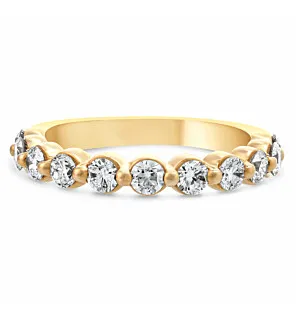
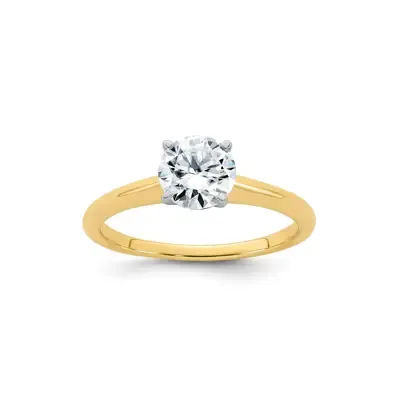
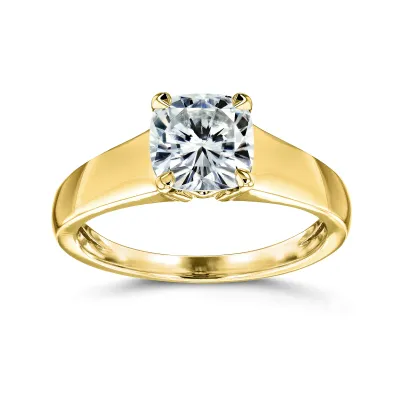
Lab-grown · 1ct round · live picks
Natural · 1ct round · live picks
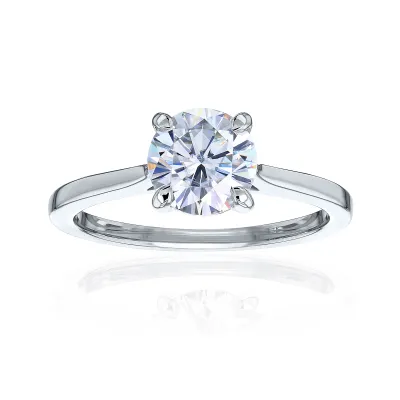
Median of the live picks above — lab-grown $850 vs natural $821. That's a live gap of roughly -4% on comparable 1ct rounds.

Resale and insurance
This is the section almost every retailer glosses over, and it's where the honest answer gets uncomfortable. Lab-grown resale is poor, and getting worse as new supply undercuts older stones. A typical 1ct lab-grown bought retail in 2023 resells for roughly 10–20% of its original price in 2026, because the equivalent new stone today costs less than what that buyer paid three years ago. Retail isn't where you sell; estate buyers and pawn shops price against today's wholesale, not yesterday's receipt.
Natural resale is better: around 30–50% of the retail purchase price for stones with GIA grading in desirable sizes (0.9–2.0ct) and specs (G+, VS2+). Still not an investment return, but a meaningful fraction recoverable. The underlying reason is supply: De Beers and other major miners are holding rough back, natural production volumes are declining (Argyle closed in 2020, several other mines are nearing end of life), and there's a persistent secondary market.
On insurance, both are insurable. The change worth noting is on the lab-grown side: some carriers now cap lab-grown replacement value against current retail, not original purchase receipt. Two implications. First, if prices keep falling, your payout in a theft or loss claim may be lower than what you paid. Second, insuring a lab-grown at its 2024 purchase price is often pointless. The replacement today costs meaningfully less. Check your policy's replacement-value language before you pay a premium calibrated to the old price.
Our rule of thumb: if the ring is a long-term store of value or intended as an heirloom, go natural. If it's a symbol and the person wearing it doesn't care what it resells for, lab-grown wins on dollar-for-dollar beauty. Don't dress this up. It's the honest trade.
Environmental & ethical considerations
The "lab-grown is greener" line is partly true and partly marketing. Lab-grown has almost no land use, almost no water use, and no mine-related community impact. It does have significant energy use. HPHT presses and CVD reactors run hot and long, and the source of that electricity matters. A CVD stone grown in Surat on grid power dominated by coal is not automatically cleaner than a natural stone mined in Canada's Northwest Territories under strict environmental regulation and indigenous-community benefit agreements. The answer depends on the specific lab-grown producer and the specific mine.

Natural mining carries well-documented impacts: overburden, tailings, water use, and in some regions labor and conflict concerns. The Kimberley Process addresses the conflict-diamond question but has real limitations: it's a government-to-government certification scheme, it doesn't audit labor conditions, and it's only as strong as the weakest participating state. Large modern mines (Diavik, Ekati, Jwaneng, Orapa) are a different animal: heavily regulated, audited, and increasingly operating with reclamation-first practices.
If ethics is actually the decision driver, the order of cleanest to least clean is roughly: recycled / antique diamonds (no new extraction, no new energy) > certified renewable-powered lab-grown (look for SCS-007 certification, which audits renewable energy and carbon neutrality) > certified-origin natural from a single known mine (Canadian, Botswanan, or fully Kimberley-compliant and traceable) > everything else.
If ethics is a secondary factor, honestly: pick whichever matches the rest of your priorities and don't over-rotate. Both industries are imperfect. Both have better and worse actors. "Lab-grown = good, mined = bad" is the bumper-sticker version and it's not quite right.
Certification
Both natural and lab-grown diamonds are graded by the same major labs: GIA, IGI, GCAL, and others. The 4Cs mean the same thing across both. A GIA-graded F VS1 Excellent-cut lab-grown looks the same on paper as a GIA-graded F VS1 Excellent-cut natural. GIA grades lab-grown on the full scale but issues distinct reports so there's no ambiguity about what you're holding.
IGI dominates lab-grown certification, widely cited as 70%+ market share on lab-grown reports, though the exact share is hard to confirm. Practical takeaway: expect most lab-grown stones online to carry an IGI report; GIA-graded lab-grown exists but is less common and commands a small premium. Every modern lab-grown grading report explicitly prints "laboratory-grown" on the face; the stone itself is usually laser-inscribed with the report number and a "LG" marker. No honest retailer will ever accidentally pass off a lab-grown as natural once a report is attached. The paperwork and the inscription are both unambiguous.
If you're deciding which lab to trust, start with our GIA vs IGI comparison. Short version: both are credible for lab-grown, GIA is tighter on natural, and you should avoid EGL and in-house store reports in either category.
When to pick lab-grown
Our opinionated list. Lab-grown is the right call if two or more of these fit:
- Size matters to the wearer and the budget is fixed. A visibly larger face-up stone at the same price is the core lab-grown case.
- Resale is genuinely off the table. Ring is a symbol, not a store of value.
- You're aiming for a 2ct+ center stone. This is where natural prices spike hardest and the lab-grown trade gets most compelling.
- You're aligned with the "new consumer" ethical frame, with lab-grown as the modern default and no mining story wanted.
- You're reinvesting the savings somewhere the wearer will see: a better setting, a bigger wedding band, a honeymoon, or paying down the ring faster.
When to pick natural
And the flipside:
- The billion-year-old-stone story matters to the wearer. This is a real, not a silly, reason.
- Resale or heirloom value matters. If this ring might be passed down, sold during a hard year, or traded up, natural holds value better.
- You're budget-unconstrained at the center stone and the price difference doesn't change what else you can afford.
- You're shopping classic sub-1ct solitaires. Under 1ct, the absolute-dollar gap between natural and lab-grown is smallest, so the "savings" are less compelling.
- You want a specific origin story: Canadian, Botswanan, or recycled antique. Lab-grown can't offer that.
FAQ
Are lab-grown diamonds real diamonds?
Yes. A lab-grown diamond is the same material as a mined diamond: pure crystalline carbon in the same atomic lattice. The FTC updated its Jewelry Guides in 2018 to drop the word "natural" from its definition of a diamond. Calling a lab-grown stone "fake" or "simulant" is wrong; moissanite and cubic zirconia are simulants, lab-grown diamonds are not.
Can a jeweler tell the difference?
Not by eye, and not with a standard diamond tester. Separating lab-grown from natural requires specialized equipment that checks for trace nitrogen patterns and luminescence under short-wave UV. Most of that testing happens at grading labs, not at the retail counter. The one reliable giveaway is the grading report: a GIA or IGI report will state whether the stone is laboratory-grown on the face of the report.
Do lab-grown diamonds pass a diamond tester?
Yes. A thermal-conductivity tester reads "diamond" on a lab-grown stone because the heat conductivity is identical. This is actually how you catch a moissanite: a moissanite triggers a separate "moissanite" flag on dual-tester devices, because moissanite conducts heat like a diamond but conducts electricity unlike one.
Will lab-grown prices keep falling?
Probably, but at a decelerating pace. Wholesale dropped roughly 80% between 2018 and 2024 as CVD reactor capacity scaled. The 2025 wholesale decline was closer to 26%, still steep but smaller than earlier years. At some point the floor is set by electricity and labor, not by reactor scarcity. The risk for buyers is less that prices crash further and more that the stone you pay $4,000 for today sells for $2,500 next year at retail, which makes resale worse.
Is a lab-grown diamond a good investment?
No, and neither is a natural one, really. Both are consumer goods that lose most of their retail value on day one. Natural diamonds hold a larger fraction of their purchase price on resale (roughly 30–50% versus 10–20% for lab-grown), but "loses less" is not the same as "gains value." The only diamonds that function as investments are exceptional, high-color, high-clarity, 3ct+ natural stones with top grading, which is a market most readers of this page are not in.
Are lab-grown diamonds ethically better?
It depends on what you're optimizing for. Lab-grown stones avoid mine-related labor and community concerns and use no new earth. They also use a lot of electricity, and the source of that electricity varies. A CVD stone grown on coal power is not obviously better than a Canadian mine operating under strict environmental regulation. Certifications like SCS-007 certify lab-grown producers who run on renewable energy. If ethics is the deciding factor, recycled diamonds and certified renewable-powered lab-grown are the strongest options.
What's the difference between moissanite and lab-grown diamond?
Moissanite is silicon carbide (SiC), a completely different material from diamond (pure carbon). It's hard (9.25 Mohs versus diamond's 10), cheap, and sparkles more intensely than a diamond because it has higher dispersion — some people love that extra fire, others find it reads as "not a diamond" in person. Lab-grown diamond is chemically identical to natural diamond. See our moissanite vs diamond comparison for the head-to-head.
Can I upgrade from lab-grown to natural later?
Usually not. Most retailer upgrade programs apply within the same category: natural to natural, lab-grown to lab-grown. Brilliant Earth, Blue Nile, and James Allen all tend to limit cross-type upgrades. The reason is that lab-grown values fall fast, so the retailer doesn't want to credit the full purchase toward a stone that's worth multiples more. Ask before you buy if upgrade flexibility matters to you.
Next steps
Shop
Lab-grown engagement rings
Live prices across our retailer feed, filtered to lab-grown only.
Shop
All engagement rings
The full catalog, compared across many online jewelers.
Compare
Moissanite vs diamond
A different kind of trade-off: silicon carbide vs carbon.
Compare
GIA vs IGI certification
Which lab to trust, especially on lab-grown reports.
Guide
The 4Cs explained
Cut, color, clarity, carat, same scales across both diamond types.
Guide
How much should a ring cost?
Budget frameworks without the 3-months-salary nonsense.
Sources
- GIA — Lab-Grown vs Natural Diamonds (canonical source on the material identity and grading approach).
- GIA — Laboratory-Grown Diamond Resources (PDF).
- IGI — Lab-Grown Diamonds (grading and certification reference).
- Edahn Golan Diamond Research & Data — edahngolan.com (wholesale price data, including the 2025 26% lab-grown decline figure).
- Bain & Company — Global Diamond Industry Report (market share and category dynamics).
- De Beers — Diamond Insight Report (natural-market context).
- SCS Global Services — SCS-007 Sustainability-Rated Diamonds Standard.
- Wikipedia — Synthetic diamond (background on HPHT and CVD; GE's 1954 Project Superpressure).
- Rapaport — rapaport.com (wholesale natural diamond price reference).
- FTC — Jewelry Guides (2018 revision removing "natural" from the diamond definition).